

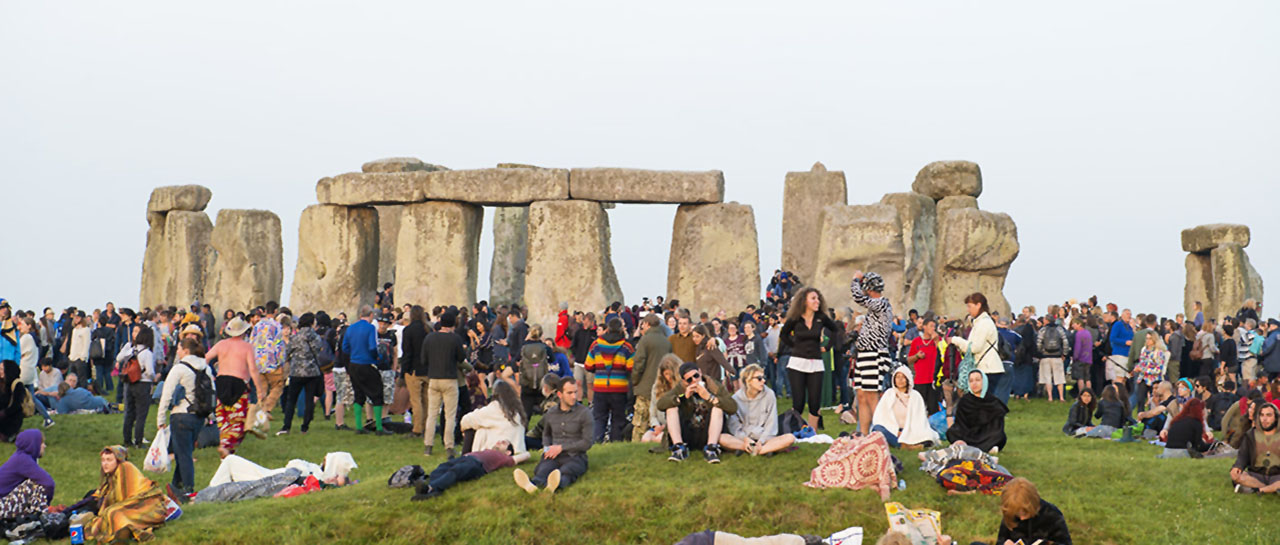
21st June is the longest day in the northern hemisphere and since ancient times, been marked in some way. The exact time of the soltice itself, ie ie the moment the earth is at its furthest tilt can range from 20-22nd June. Pagans call it Litha and it is the celebration of the Goddess and God of fertility at the appex of their power. The Celts celebrated Litha with hilltop bonfires and dancing. Many people attempted to jump over or through the bonfires for good luck.
The word Solstice comes from the Latin term solstitium (“sun stands still), because on the solstice it is at its highest point before it starts to go down again. Many ancient monuments such as Stonehenge are aligned to the rising sun.
In agrarian times.
Midsummer celebrations in Sweden were held to welcome summertime and the season of fertility. In some areas people dressed up as 'green men', clad in ferns. They also decorated their houses and farm tools with foliage, and raised tall, leafy maypoles to dance around, probably as early as the 1500s.
Making a bonfire on a hilltop, sing, drink, laugh and time of merry-making. In the Wiccan tradition it is one of the 8 circle of life celebrations known as Litha. Processions with torches and lanterns, rolling wheel down hill to mark the start of the sun's descent, blessing cakes and wine, waiting for the dawn and greeting the sun when it rises, sleeping by a spring, rolling naked in the dew of the summer sunrise!
There has been confusion over why midsummers eve is not the same day as the Solstice. Midsummer's Day, i.e. the middle of summer, in Europe was traditionally celebrated on 24 June, which is after the Summer Solstice which is the longest day. In earlier times, before the change of calendars, Midsummer's day fell on 5 July. This discrepancy is said to have been caused by the variants of the Julian Calendar and the Tropical Year further confused by the Gregorian Calendar.
Midsummer’s Eve was considered magical in Cornwall and Ireland, when there was feasting, fires, songs, and dances. Bonfires were kindled on high hills to commemorate the high point of the year. Traditionally, the veil is thin, at this time, between the dimensions housing the living and the dead as it is said to be at Halloween
Southern Hemisphere
In the Southern Hemisphere this will be the Winter solstice celebrating the return of the sun.