

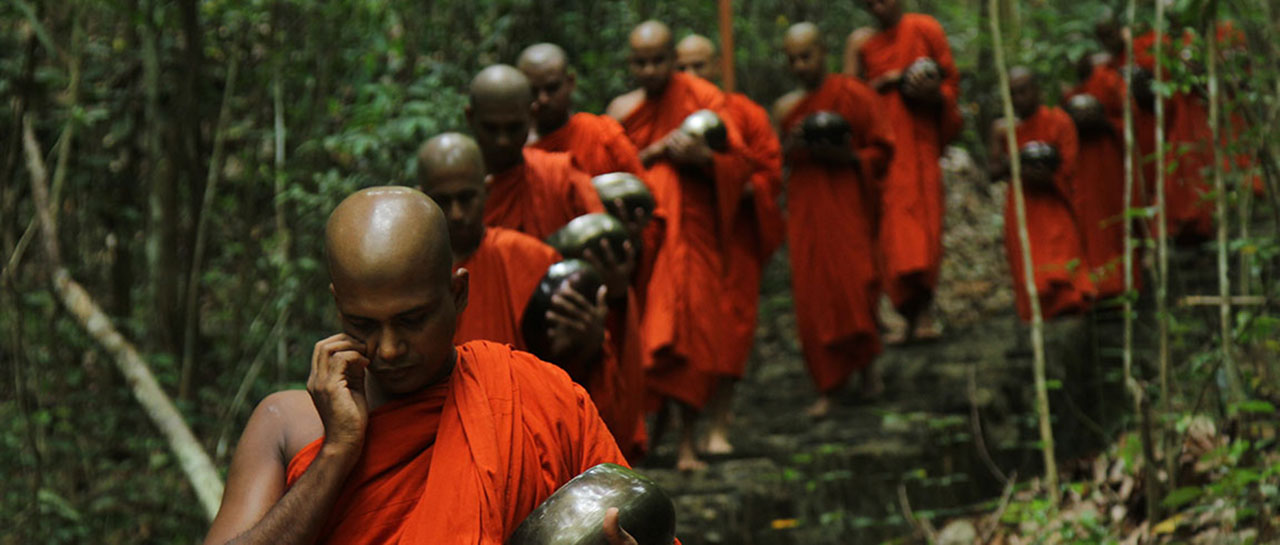
Mahayana (Buddhism’s New Year) is based on the Luna calendar and takes place on the first full moon in January. It is the largest of the three major tradition of Buddhism today those being Theravada, Mahayana and Vajrayana, because Mahayana has spread so widely around the world.
From Northern India, through Nepal, Tibet, Bhutan, China, Japan, Bangladesh, Vietnam, Korea, Taiwan, Sri Lanka, Malaysia, Singapore and Mongolia as well as the rest of the world. The new year itself depends upon the particular country of origin as well which is why the date can vary from country to country. Whenever the celebration, the idea behind the celebrations is based on the belief that by burning a symbolic black pyramid they are burning away the sins (or negative karma) from the previous year thus leaving them spiritually clean and fresh to enter the new year.
The difference between the three major schools of Buddhism.
Theravada (also known as Hinayana, the vehicle of the Hearers), Mahayana, and Vajrayana. These are recognised by practitioners as the three main routes to enlightenment or awakening known as Bodhi, the state that marks the culmination of all the Buddhist religious paths. Theravada is the only remaining tradition stemming from Early Buddhism. Its central texts are in Pali (the language in the region at the time Buddha lived). Its devotees are exclusively monanestic and they each individually strive to become enlightened.
Mahayana has Sanskrit as its main base language, and both monastic and lay people work for the liberation of all sentient beings, making compassion and wisdom (insight) the core of its central doctrines.The perfection of these human values culminates in the Bodhisattva (means an enlightened being or one who is oriented to enlightenment), which is a model for a life of service to others, putting aside all ideas which would be considered self-serving. This is in direct contrast the Theravada. The ideal which followers of Buddhism aim for is inspired by the life story of Buddha who began life as a Prince, and left the pampered environment of his home and wandered the region searching for enlightenment which he famously found under the Bhodi tree. He then embarked on a religious life by cultivating the Six Perfections, the Four Noble Truths and the Eight Fold Path. Current Tibetan Buddhism evolved from this path and devolved into the Gulag tradition (the Yellow Hats) of which the Dali Lama is head, The Nyingma, Sakay, and Kagyu sects known as the Red Hats and the lesser known Black Hats of the Karma Kagyu sect. (as with all religions the teachings stem from one place with many differing interpretations as society expands and evolves).
The term Bodhicitta is used to describe the state of mind of a Bodhisattva, (the person seeking enlightenment) to which there are 2 aspects i.e., a mind directed towards enlightenment, and the ceasing of all cravings and attachments. A mind whose very nature is enlightenment. A Bodhisattva places themselves in the position of others in order to be totally selfless and embody the essence of compassion. This allows the whole community become enlightened and lay people and monks are of equal importance.
Vajrayana, the Diamond School, was originally exclusive to Tibet. When China invaded Tibet in 1953 & 1957 the Chinese occupation of Tibet forced it out of the country and other schools of Buddhism were introduced such as Zen and Mahayanas. Vajrayana emphasizes the permanence of the Buddha's teachings as symbolized by the vajra (thunderbolt), a ritual implement used for ceremonies. IMAGE It also employs Tantra which are techniques to reach enlightenment more quickly and mainly focusses on lay people.
It is significant that the Theravada texts exclusively concern the Buddha’s life and early teachings; whereas, due to spreading of his teaching far and wide , Mahayana and Vajrayana texts appear in many languages and contain a mixture of ideas. Early texts were probably composed in southern India and confined to strict monastic Buddhism, the later texts were probably written in northern India and were no longer confined to the monasteries but to the lay population as well.
For further information see https://www.ancient.eu/Mahayana_Buddhism/